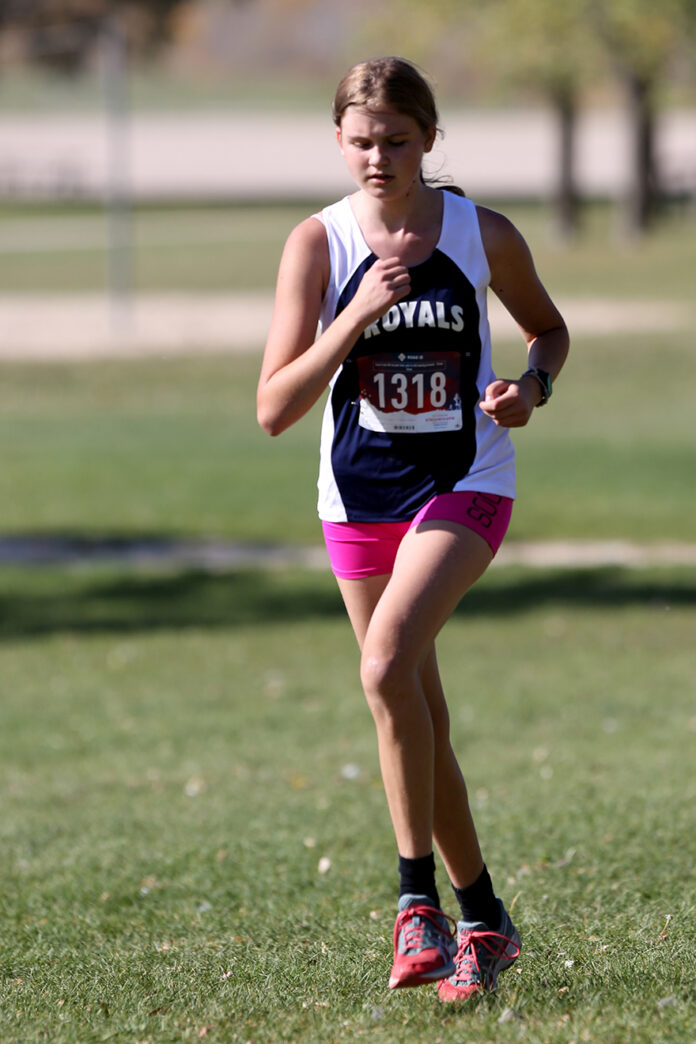
The Lord Selkirk Royals cross country team was back in action at Birds Hill Provincial Park on Oct. 6 as they competed in the third Kilcona Peguis Athletic Conference cross country meet of the 2021 season.
Royals compete at cross country meet
Blue Bombers unveil orange jerseys in recognition of Orange Shirt Day
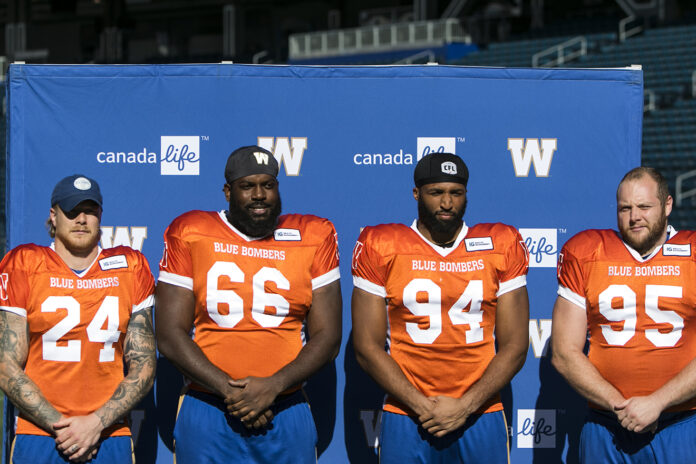
The Winnipeg Blue Bombers unveiled New Era jerseys, which will be worn by the Winnipeg Blue Bombers and the visiting Edmonton Elks for the pre-game warmup to recognize Orange Shirt Day on Oct.8
The jerseys will be made available for an online auction following the Canadian Football League game, with funds raised donated to each team’s charity of choice.
The Bombers selected the Winnipeg Aboriginal Sport Achievement Centre, a foundation that helps to remove barriers for thousands of children annually and is Canada’s largest employer for Indigenous children and youth.
The Elks will be donating proceeds to Spirit North, a national charitable organization dedicated to improving the health and wellness of Indigenous children and youth through the transformative power of sport and play.
Proving stepping up preparedness for COVID-19 fourth wave, moving to restricted (orange) level on pandemic response system

Expansion of Proof of Vaccination, New Public Health Orders and Health System Protocols Will Help Protect Hospitals: Gordon
Manitoba is taking additional steps to protect Manitobans and maintain health services, including non-COVID-19 care, during a fourth wave of the pandemic, Health and Seniors Care Minister Audrey Gordon and Dr. Brent Roussin, chief provincial public health officer, announced today. “Rising case counts and COVID-19 transmission in the province means we need to introduce new measures now to reduce the impact of a fourth wave of COVID-19 on our hospitals,” said Gordon. “Case counts and hospitalizations are rising everywhere in Canada, and Manitoba is not immune. That is why we must be proactive now.” The minister noted Manitoba’s progress on vaccination remains one of the best in the country with 80.4 per cent of eligible Manitobans fully vaccinated and 84.9 per cent who have received at least one dose as of Wednesday. But case numbers and hospitalizations are now increasing, noted Gordon, especially among the nearly 400,000 unvaccinated Manitobans, which will place the province’s medical care system at risk if the rise continues unabated. As of Wednesday, people who are not fully vaccinated accounted for 75 per cent of new COVID-19 cases, 79 per cent of those admitted to hospital and 100 per cent of intensive care unit (ICU) admissions.
Data also shows that hospital admissions related to COVID-19 have increased by 26 per cent in the past week with COVID-19 related admissions to ICU increasing by 17 per cent during that same period. Should this continue, Roussin cautioned access to other medical care in hospitals will have to be reduced or halted to ensure sufficient ICU capacity for COVID-19 care is available.
To increase COVID-19 preparedness and address the fourth wave, the province is taking three new steps to help reduce COVID-19 transmission:
• moving to the restricted (orange) level on the Pandemic Response System;
• introducing additional public health orders that expand requirements for proof of immunization and reduce gathering sizes when unvaccinated individuals are present; and
• implementing new patient protocols to ensure additional health system capacity when needed.
The COVID-19 response level on the province’s Pandemic Response System is being raised to restricted (orange) from caution (yellow) to reflect the increased severity of risk. Roussin noted the move to the restricted (orange) level will not affect schools. Schools will remain at the caution (yellow) level at this time to ensure youth can remain in school as much as possible. At this time, public health officials continue to recommend a school-specific approach when risk is identified.
New public health orders will allow fully vaccinated Manitobans to continue to enjoy as much freedom and as few restrictions as possible. Unvaccinated individuals who are eligible to be vaccinated will now be more restricted in their activities. This includes: • limiting private indoor gatherings for households to guests from one other household when any unvaccinated person who is eligible to be vaccinated is present on the property (even if the unvaccinated person lives at that location);
• limiting private outdoor gatherings for households to 10 guests when any unvaccinated person who is eligible to be vaccinated is present on the property (even if the unvaccinated person lives at that location);
• reducing indoor public gathering group sizes to 25 people or 25 per cent capacity, whichever is lower, for gatherings that include unvaccinated people who are eligible to be vaccinated, including weddings and funerals; and
• setting indoor group sizes for faith-based gatherings to 25 people or 33 per cent capacity, whichever is greater, for gatherings that include unvaccinated people who are eligible to be vaccinated.
Fully immunized Manitobans and those under 12 who are not eligible for the vaccine may gather without capacity limits in each of these areas. Household gatherings, weddings, funerals and faith-based gatherings can occur for fully vaccinated individuals and those under 12 without any restrictions. For example, faith-based gatherings may take place with a choice of services at their discretion for fully immunized worshippers (no restrictions) or unvaccinated worshippers (restricted capacity as set out above).
In addition, gated or controlled events and gatherings where proof of vaccination is required will continue to be permitted. The public health orders will also:
• reduce all outdoor public gathering sizes to 50 people; and
• move retail capacity to 50 per cent in the Southern Health-Santé Sud health region to help reduce the spread of COVID-19 in this region.
The new orders will come into effect on Tuesday, Oct. 5 at 12:01 a.m., with an additional one-week grace period for weddings and funerals already scheduled to minimize disruption.
Roussin noted that fully vaccinated Manitobans and Manitobans who are not eligible for vaccination will be largely unaffected by these new orders. “Our data shows that vaccination works, as the vast majority of hospitalizations and ICU admissions are in people who are unvaccinated,” said Roussin. “But nearly 400,000 Manitobans are either unable or unwilling to get vaccinated and our health-care system remains at risk from the delta variant of COVID-19 with case numbers and hospitalizations rising. Today’s announcements are the consequences of that reality.”
Future changes may include requiring all those eligible to be vaccinated to provide proof of vaccination to participate in indoor recreational activities and allowing partially vaccinated youth aged 12 to 17 (with one vaccine dose) to participate. Conversations will continue with sports organizations and other stakeholders to seek feedback.
“More than 80 per cent of eligible Manitobans have gotten vaccinated to protect their own health and those around them, and we thank you for that,” said Gordon. “But right now, there are nearly 400,000 people who are not immunized in Manitoba and they are at a high risk of infection. If you want to keep children in schools and ensure medical procedures people need are not postponed, please get vaccinated now.”
Gordon noted the province’s critical care capacity must remain protected for patients. New protocols will be put in place to protect capacity at sites that support patients in intensive care units, as well as those in need of surgery. Patients admitted to a hospital or health-care facility for care will be assessed for their individual care requirements and may be transferred to the most appropriate facility in Manitoba with the capacity to meet their needs in order to maintain vital ICU capacity. This may mean patients are medically transferred at no cost to another Manitoba facility located outside their home community. This includes patients who live in Winnipeg.
Staffing complements for ICUs have been intensified. The minister noted additional nurses trained to support patients in need of critical care have been made ready in recent months. This includes more than 137 nurses who completed a two-week general ICU orientation course offered between April and July 2021, as well as 67 nurses who have completed or are currently enrolled in a 12-week critical care orientation program. Further opportunities for nurses to complete this specialized training will be rolled out.
“Vaccines have been shown to reduce the serious effects of COVID-19 and lessen the need for hospital care. With unvaccinated people requiring care in our hospitals and ICUs, these steps are necessary to maintain critical care capacity for all other patients in our hospitals,” said Gordon. “COVID-19 has created a heartbreaking backlog of surgeries and other medical procedures right across the country. Every new COVID-19 patient that requires hospital or ICU care can delay needed care for someone else.”
For more information on COVID-19 in Manitoba, visit www.gov.mb.ca/covid19.
– 30 –
Steelers earn first win of season

The Selkirk Settlers earned their first win of the 2021-2022 Manitoba Junior Hockey League season.
Selkirk eared a 3-2 victory when they faced off against the Winnipeg Freeze at the Jonathan Toews Sportsplex in Winnipeg on Oct. 1.
Statement from Premier Kelvin Goertzen and Indigenous Reconciliation and Northern Relations Minister Alan Lagimodiere on National Day for Truth and Reconciliation

On Sept. 30 we recognize National Day for Truth and Reconciliation, and encourage all Manitobans to join the provincial government to learn and engage in meaningful discussions about residential schools and its tragic enduring legacy in our country.
In June, the House of Commons passed Bill C-5, establishing a new federal statutory holiday, National Day for Truth and Reconciliation to be observed on Sept. 30 annually starting this year. The Manitoba government has also recognized this day as a day of observance to encourage reflection and meaningful discussions about the impacts of residential schools.
Observing today is vital to memorializing residential school experiences, witnessing and honouring the healing journeys of survivors and their families, and committing to the ongoing process of reconciliation.
National Day for Truth and Reconciliation is just one-step in the process to heal the relationship with Indigenous peoples by having meaningful discussions about the trauma Indigenous peoples and their families have faced and to build a bridge to a new, healthier, more positive and productive relationship.
We all have a role to play in the reconciliation and healing process for Indigenous peoples who have suffered the physical and emotional trauma of the residential school system and with recent tragic discoveries on the grounds of residential schools across Canada makes this day even more significant.
In 2017, Manitoba passed legislation to recognize formally Sept. 30 as Orange Shirt Day to encourage meaningful discussions about the trauma of residential schools.
Flags on all provincial government buildings will be lowered today to half-mast to align with long-standing protocol for all National Days of Observance. Schools and non-essential government services and offices will also be closed for the day to observe the National Day for Truth and Reconciliation. At sunset, the Legislative Building will be lit up with an orange Every Child Matters graphic to honour the children that never returned home from residential schools. The graphic was designed by Natalie Thiessen in partnership with Manitoba Keewatinowi Okimakanak Inc.
– 30 –
Jets outshoot, outscore Oilers

After two periods of play in the National Hockey League tilt between the visiting Edmonton Oilers and home town Winnipeg Jets, Winnipeg leads 4-1.
Winnipeg’s Jansen Harkins opened the scoring in the first period, which proved to be the lone goal of the opening frame.
The Jets continued the momentum into the second period when Evgeny Svechnikow, Austin Poganski and Harkins all netted goals before Edmonton’s Brad Malone beat Winnipeg’s goaltender Connor Hellebuycki.
Jets forward Kyle Connor scored the lone goal of the third period to help secure the 5-1 victory over the Oilers.
The Jets out scored the Oilers 28 to 18.
Winnipeg takes on the Oilers in Edmonton on Oct. 2.
Researching your family’s history
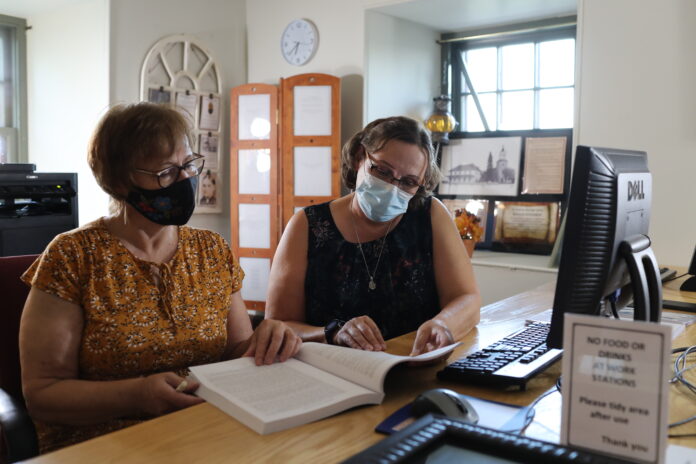
The Red River Ancestry Genealogy Centre has now opened at the St. Andrews Rectory.
Cancelled: 2022 Manitoba Games powered by Manitoba Hydro

| To keep Manitobans safe and prevent the spread of COVID-19, Sport Manitoba and the Niverville host society are announcing the cancellation of the 2022 Manitoba Games powered by Manitoba Hydro. The Games were scheduled to take place in Niverville from February 27 – March 5, 2022. The scope of these Games encompassed upwards of 1,500 participants from all across the province (athletes, coaches, managers, officials), and 1,000 local volunteers organizing 12 sports over seven days in and around the Town of Niverville. Over the last 18 months, inconsistencies in competition and training opportunities had an effect on athlete development. Without regular training, conditioning, and recovery routines in this crucial stage, the risk of injury, mental fatigue, and overtraining were also factors in making this decision. Along with continued uncertainty about the pandemic, and public health restrictions, it became clear it would not be possible to host an event of this magnitude and execute a safe and successful multi-sport Games experience. Sport Manitoba and the Niverville host society worked with the Town of Niverville, provincial sport organizations, Hanover School Division, public health, and Games partners to evaluate a number of options before reaching the collective decision to cancel the event. The support of our title sponsor, Manitoba Hydro, as well as our presenting sponsors, Credit Unions of Manitoba, Calm Air, Konica Minolta, Travel Manitoba, and the Manitoba Dental Association, was welcomed in making this decision. The host society remained committed and dedicated as it planned through so many unknowns over the last year. To give them an opportunity to follow through on some of the benefits of hosting a Manitoba Games, Sport Manitoba is guaranteeing $150,000 for capital projects. Some projects, like the cross country ski trails at Hespeler Park, have already benefited from this investment. The funds that remain will be allocated within the community to enhance sport infrastructure and equipment. The Town of Niverville has been offered the first right of refusal to host the 2026 Manitoba Games powered by Manitoba Hydro in the Winter of 2026, which is the next Games available to host. The Manitoba Games powered by Manitoba Hydro is staged every two years, alternates between summer and winter sports, and is the largest ongoing multi-sport event in the province. Each Games involves upwards of 3,000 athletes, coaches, officials, and volunteers, and represents an opportunity for young athletes to compete and prepare to reach national and international sporting stages. |
Jets lose close game to Senators

The Winnipeg Jets faced off against the visiting Ottawa Senators at Canada Life Place in Winnipeg on Sept. 26.
It wasn’t the outcome Winnipeg was looking for as Ottawa earned a 3-2 overtime victory.
The Jets play the visiting Edmonton Oilers at Canada Life Place on Sept. 29.
Selkirk putting Street Tree Policy into action with 64 trees this fall
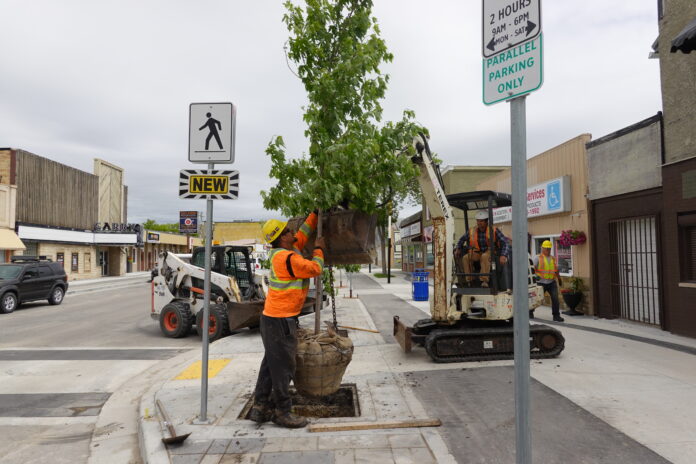
The City of Selkirk will plant 64 trees along city boulevards this fall, the first of many to be planted over the coming five years, and the policy behind the green initiative is receiving high praise from a group that leaves nothing to chance when it comes to trees.
The Trees Please Winnipeg Coalition – residents from Winnipeg neighbourhoods who lobby all levels of government to make long-term, sustainable infrastructure investment available to cities for the maintenance, diversification and expansion of urban forests – invited Selkirk to make a presentation to its board of directors. In turn, the city asked them to review Selkirk’s new Street Tree Policy, then in its draft form.
To say the folks from Trees Please were pleased would be an understatement. Erna Buffie, Interim Chair and Emma Duran-Wood, a volunteer with the coalition, say the policy is inspiring and they would like to see something similar implemented in our capital city.
“Selkirk hasn’t just taken the lead on its street tree policy, it’s leading Manitoba and most of the nation with its comprehensive climate change strategy and resiliency plan,” Buffie said.
“Putting natural infrastructure, like the urban forest, at the heart of that strategy will guarantee a safer, more resilient environment for future generations.”
Selkirk’s Street Tree Policy has several objectives, including to ‘proactively manage and sustain the city’s Street Trees in an arboriculturally sound and cost-effective manner that provides the greatest environmental, economic, and social benefit to residents, to protect the city’s road infrastructure from heat and ultraviolet rays and to relieve pressure from the city’s storm drainage network by using street trees to better manage storm water.
CAO Duane Nicol says the policy provides guidance to the city and makes trees part of its critical municipal infrastructure, which therefore have to be invested in and maintained as part of Selkirk asset management.
“Over the past couple of years the city has been building its capacity to properly manage our urban canopy by training staff, purchasing equipment and getting into the habit and practice of planning tree maintenance. One of the things our policy outlines is it’s not just about planting, it’s about care for the trees after,” Nicol said.
“The first couple of years after being planted, to get the trees established and off to a healthy start, proper water and care and maintenance for those trees is critical. We’ll be planting a lot of trees over the next five years, and that’s a substantial investment of city staff time to do that properly, but the return on that investment is significant over the next 50 or 100 years. We’re going to make those investments and we’re going to reap the benefits for decades to come.”
Dan McDermid, Director of Operations, said the city will begin planting 18 different tree species this fall on portions of Robinson, Manitoba, Agnes and Sophia.
“We used our street tree policy to determine which trees we were planting. They are Manitoba produced and there’s many different types,” McDermid said.
The policy dictates the city plant a variety of trees to diversify its urban forest to make it more resilient to invasive species as well as climate change.
“When we were developing the list of target species in the policy, we were looking for more native species that are going to thrive under the future climate conditions that we can expect here in Selkirk,” Nicol said.
Street trees need to be more tolerant to the stressors that they face being located alongside a roadway, but the benefits they provide are many. Street trees provide shade and reduce the temperature on the roadway, resulting in a longer lifespan of the road; absorb rainwater and reduce the burden on drainage systems and combined sewers; and absorb CO2 and pollutants from vehicles.
McDermid said studies also show that street trees provide a calming effect and even help make streets safer because motorists tend to reduce their speeds when travelling down a tree-lined thoroughfare.
Walkable Communities’ Urban Street Trees – 22 Benefits includes among them that street trees result in fewer mid-block crashes and that they do have a calming influence. The link to the benefits can be found on Trees Please Winnipeg’s website, treespleasewinnipeg.com.
“(Selkirk’s Street Tree policy) includes pretty much everything Trees Please would like to see implemented in Winnipeg – a strong emphasis on forest expansion, tree diversification and best urban forestry practices like timely maintenance and pruning,” Buffie said.
“Most importantly, it has a clear and sustainable funding strategy. Everyone in Selkirk should be incredibly proud of it.”